Cream Legbar: Sourced Blue Egg and Weight Facts
Compare sourced Cream Legbar records for blue egg color, annual egg estimates, mature weights, single comb, non-hybrid status, and maturity.
Egg production estimates by source
Each egg is 20 eggs/year. Solid = published minimum; outline = rest of the range. Scale goes to 320.
Mature weights by source
Quick facts
| Attribute | Value | Source |
|---|---|---|
| Egg Color | blue |
|
| Eggs Per Year | 180–200 eggs/year |
|
| Hen Weight Lb | 5 lb |
|
| Rooster Weight Lb | 6 lb |
|
| Maturity Weeks | 22–24 weeks |
|
| Comb Type | single |
|
| Temperament | friendly, active |
|
| Climate Tolerance | all climates |
|
| Apa Class | not recognized |
|
| Breed Type | non-hybrid |
|
Overview
The retained Cream Legbar records describe blue egg color, an annual egg estimate, mature weights, laying maturity, a single comb, and a non-hybrid classification. This profile reports those catalog fields at source scope. It does not use the editorial image to identify the breed or infer any attribute.
Egg records
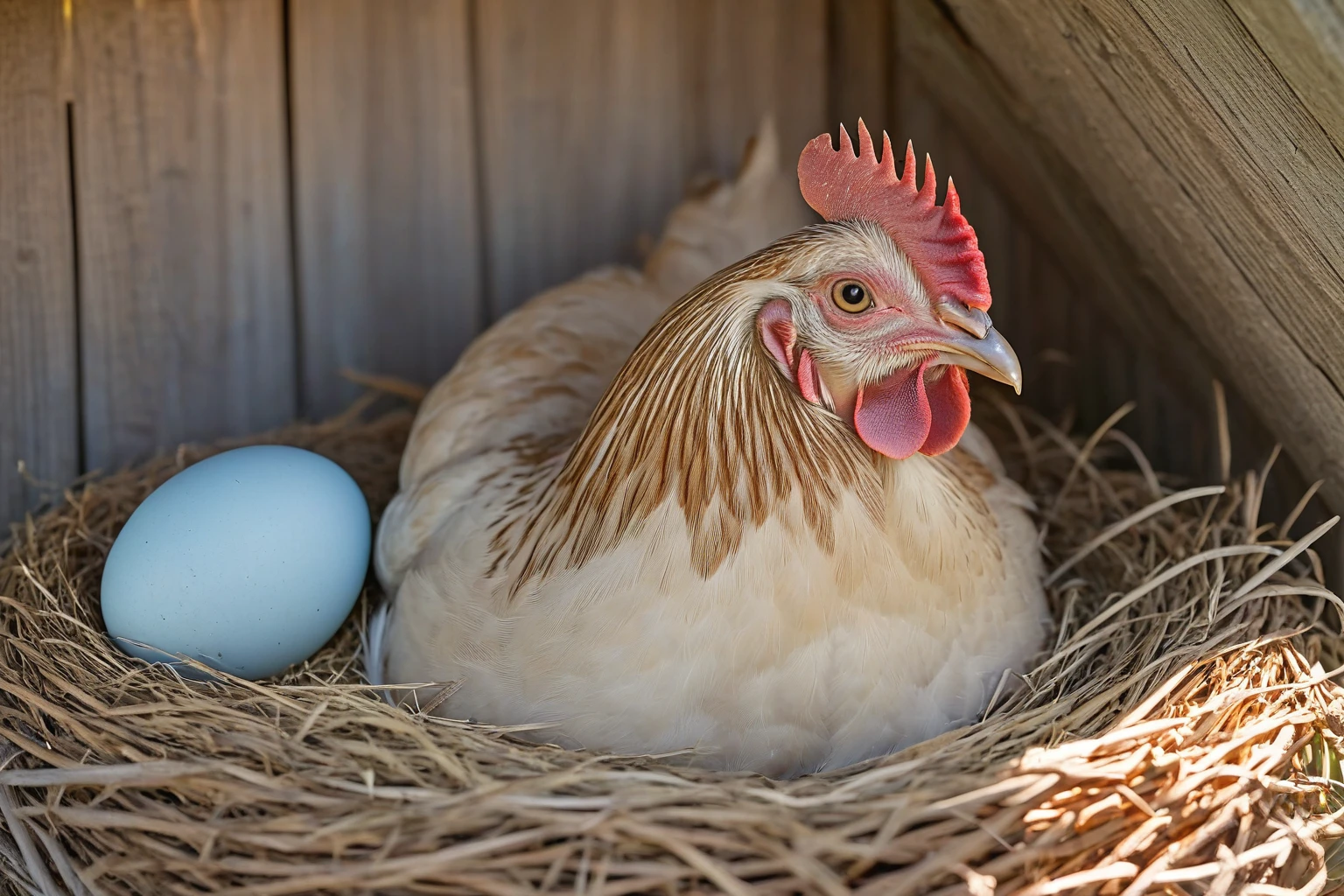
McMurray Hatchery's retained sentence says Cream Legbar chickens lay a blue egg. That sentence supports the blue label used here and on the published egg-color reference. The page does not broaden blue into a range of other shell colors because the retained McMurray sentence names only blue.
Cackle Hatchery lists an estimated annual output of 180–200 eggs. The lower and upper bounds are stored as numeric values with an eggs-per-year unit, rather than as one display string. That representation lets the quick-facts table display the source range and lets the chart calculate a midpoint without treating that midpoint as a new source claim.
Only one annual production range is retained, so the page does not claim agreement between sellers or convert the range into a weekly rate. The source describes an estimate, not a guaranteed result for an individual bird. Keeping that limit visible is more accurate than adding a second figure whose surrounding evidence does not meet this page's gate.
Weight and maturity records
Cackle lists a hen weight of 5 pounds. Meyer Hatchery independently lists hens at 5 pounds and roosters at 6 pounds. The two retained hen records agree, while the published rooster field uses only Meyer's supported 6-pound value. Each record remains separately linked in the fact table even when the displayed hen values are identical.
Meyer lists laying maturity at 22–24 weeks. That range is stored with numeric endpoints and a weeks unit. It is not converted to months, and it is not described as earlier or later than another breed because neither conversion nor comparison appears in the retained fact record.
The retained numbers support the displayed annual estimate, sex-specific mature weights, and maturity range. They do not establish a body-size label, growth curve, feed requirement, space requirement, or expected output under a particular management system. This profile leaves those fields unclaimed.
Other sourced fields
Meyer's product record pairs the Comb Type label with the value Single. It separately pairs the Hybrid label with No. This page therefore records the comb as single and the breed type as non-hybrid. It does not substitute the earlier draft's unsupported pea-comb or hybrid labels.
The same record lists the personality field as friendly and active, the hardiness field as hardy in all climates, and the APA class as not recognized. These phrases are retained as seller catalog labels, not as universal predictions about an individual bird or instructions for any climate.
The published evidence set is intentionally narrow. Earlier prose about origin, dates, popularity, rarity, auto-sexing details, inherited traits, handling, housing, and medical topics is omitted because those claims were not supported by the retained records at the required granularity. The fact table exposes the exact source passage used for every remaining field.
Related published pages
Flock size calculator
Enter your household size and target egg output. The calculator returns the flock size and space you'll need based on the productivity tier you pick.
Hens needed: 3
(4 × 2 eggs/week / 3 eggs/hen/week, rounded up)
Coop space: 6 sq ft (2 sq ft/hen × 3 hens)
Run space: 30 sq ft (10 sq ft/hen × 3 hens)
These are minimums. Most backyard keepers give 1.5–2× this much space, especially for run area, to allow range rotation and reduce feather-picking behavior.
Where these numbers come from
- Low tier 3 eggs/hen/week — Egg Production: 150 – 280 eggs per year www.cacklehatchery.com
- Medium tier 5 eggs/hen/week — Egg Production: 200-280 eggs per year www.cacklehatchery.com
- High tier 6 eggs/hen/week — Cackle lists White Leghorns as producing large to extra-large white eggs, with an estimated 280–320 eggs per year. www.cacklehatchery.com
- Coop 2 sq ft + run 10 sq ft per large chicken (minimum) — A small bantam chicken needs a minimum of 1 square foot of indoor space and 4 square feet of outdoor space, while a large chicken needs a minimum of 2 square feet of indoor space and 10 square feet of outdoor space. extension.msstate.edu
Frequently asked questions
What egg color do the retained Cream Legbar records list?
McMurray Hatchery says Cream Legbar chickens lay a blue egg.
What annual egg estimate is retained?
Cackle Hatchery lists an estimate of 180–200 eggs per year.
What comb and hybrid fields are retained?
Meyer Hatchery lists a single comb and marks Hybrid as No; this page records that as non-hybrid.